Poker Chats and Opponent Notes: What You Can Use Without Sanctions in 2026
In 2026, most major poker rooms treat fairness and data use as a security issue, not a grey area. That matters because “notes” can mean anything from a quick reminder like “over-folds river” to automated profiles built from large databases. The first kind is usually fine; the second can trigger warnings, confiscations, or bans depending on the room. This guide explains what is generally safe, what is commonly restricted, and how to keep your note-taking and chat habits firmly on the compliant side.
Opponent notes: what counts as “safe” information
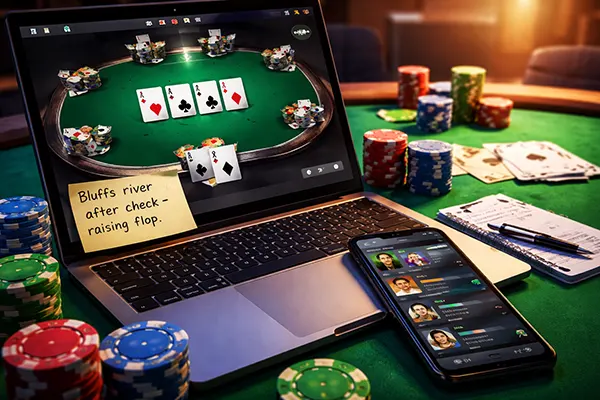
The safest opponent notes are the ones you could have written with pen and paper based only on what you personally observed at the table. Think in terms of patterns you actually saw: showdowns, bet sizing habits, timing tendencies, and recurring lines (for example, “check-raises flop draws, gives up turn”). These notes do not require external data, and they do not automate decision-making; they simply help you remember what happened.
A practical approach is to write notes as short, neutral statements with context: include the game type, stack depth, and what you saw at showdown. “Called three streets with second pair in SRP at ~40bb” is more useful (and safer) than vague labels like “fish” or “maniac”. If your room allows colour tags, they can be used as memory aids, but keep them factual: “wide limp/call”, “over-defends BB”, “thin value bets”.
Avoid turning notes into personal data. Do not store real names, locations, payment hints, social media references, or anything that looks like an attempt to identify a player beyond what the room itself shows you. Even if a room does not explicitly list every type of personal detail, many terms treat harassment, targeting, and privacy breaches as sanctionable behaviour, and it is not worth testing that boundary.
Where notes become risky: databases, data mining, and automation
The biggest compliance mistake is confusing “study” with “collection”. Many rooms draw a hard line at tools or services that build large hand-history databases or enable mass analysis of opponents. If you are importing hands to create long-term opponent profiles, or using third-party services that collate non-public hand histories, you are moving into restricted territory on a lot of networks.
Automation is another red flag. If a tool is taking notes for you, generating opponent labels automatically, or running scripts while the poker client is open, it can be treated as prohibited assistance even if you still click the buttons yourself. In 2026, the enforcement trend is simple: the more a tool reduces manual work during live play, the more likely it is to be restricted.
Real-time advice is the clearest “do not”. Anything that reads the current game state and tells you what to do (or meaningfully narrows your decision) is typically treated as cheating. Even “light” versions, like dynamic overlays that change recommended lines by position and situation, can be viewed as too close to real-time assistance on stricter sites.
Table chat: what is usually allowed, and what can get you flagged
Table chat is generally allowed for basic conversation and etiquette, but it is monitored in the same way as any other in-client behaviour. The easiest way to stay safe is to keep chat non-strategic during hands. Friendly banter, clarifying a misclick, or simple “gg” messages are rarely an issue, while anything that looks like coordination can be treated as collusion.
Do not use chat to share hand strength, folded cards, or “I had it” hints while action is ongoing. Even if you think you are only teasing, it can affect decisions at the table and create a record that security teams can review later. Similarly, do not discuss “let’s check it down”, “we’ll split”, “I’ll fold to you” or any deal-making language. These phrases are classic markers for soft play and chip-dumping investigations.
Harassment and targeting are another fast route to sanctions. Insults, pressure, threats, discriminatory language, or repeated attempts to provoke a reaction can be punished even if your play is clean. If you want to tag a player for emotional reasons (“tilts easily”), do it privately in a neutral way and keep chat out of it.
Chat-related traps: multi-tabling, streaming, and “helpful” friends
Multi-tabling increases risk because players sometimes copy and paste notes or talk strategy impulsively while juggling tables. If you are playing several tables, treat chat like a distraction you simply do not need. Many investigations start from something small: one message that looks like coordination, followed by a routine review of your sessions.
If you stream your play or discuss hands in public channels, separate “live play” from “review”. Talking through exact decisions while you are still in-session can be interpreted as receiving or providing real-time help, depending on the room’s policies and how interactive the stream is. A safer habit is to mark hands and review them after the session ends, with a delay and without the audience influencing actions.
Also be careful with off-client communication. If you are in a voice call with friends while playing the same games, you can be accused of sharing information even if you never intended to collude. Many rooms treat any real-time strategic discussion during play as a risk factor. If you want to study together, do it using hand histories after the fact, not while cards are being dealt.
Room-by-room realities in 2026: how to stay compliant across different policies
There is no single universal standard, because each room defines “unfair advantage” differently. Some sites allow limited tracking and HUD use with restrictions; others prohibit third-party trackers entirely and instead offer built-in session summaries or anonymised environments. Your safest baseline is to assume strict rules unless you have read the room’s current third-party tool policy.
As an example of a stricter posture, some networks explicitly prohibit common trackers and large-scale analysis tooling, as well as automated note-taking scripts and remote-access tools while playing. That means even if you personally use a tool only “to review later”, the room may still restrict having it running alongside the client or using it in ways that resemble mass profiling.
Other rooms focus on limiting live overlays rather than banning all study. They may allow hand review and certain convenience tools, but they still prohibit anything that acts like a bot or provides real-time advice. The practical takeaway is that “post-session study” is usually safer than “live assistance”, and manual notes are safer than automated profiles.
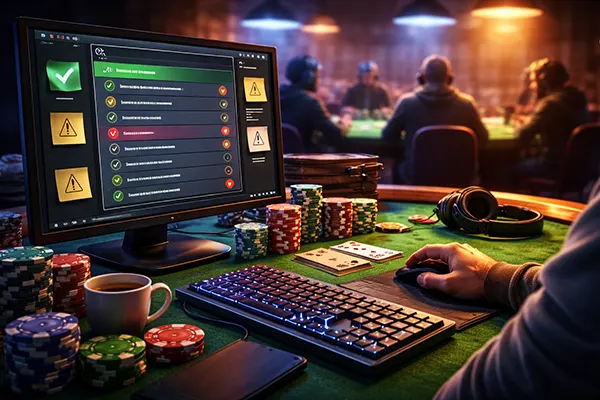
A simple compliance checklist you can apply before every session
First, decide what your notes are for: memory, not prediction engines. Write only what you saw, add context, and keep the language neutral. If you ever catch yourself copying in statistics, external labels, or long-term opponent profiles built from data you did not personally generate at the table, pause and reassess whether the room allows it.
Second, keep your “playing setup” clean. Close remote access software, disable scripts, and avoid any tools that take actions, collect hands at scale, or change advice based on live game state. If a room provides a permitted-tools list, treat it literally: if the tool is not on the list, assume it is not allowed while the client is open.
Third, separate play from review. Mark hands, export what the room permits, and analyse afterwards. If you want richer feedback, use coaching, solvers, or trackers only in a post-session environment and only in ways the room explicitly allows. That one habit—clear separation—does more to reduce sanction risk than any clever note format ever will.