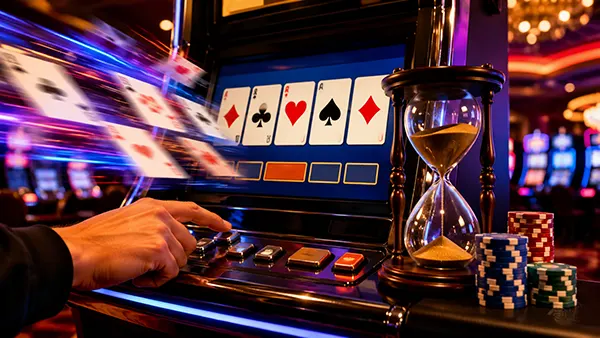
The psychology of loss chasing in poker: how to stop chase sessions and rebuild discipline
Loss chasing in poker is the moment your goal quietly shifts from playing well to “getting back to even”. It can happen to beginners and experienced grinders alike: you feel a loss as unfinished business, your patience shrinks, and you start making choices to repair your mood rather than to maximise long-term expected value.
How loss chasing shows up at the tables
The most common sign is a change in what you optimise for. Instead of thinking in big blinds, ranges, and spots, you think in “recovering today”. That single sentence is enough to distort your entire strategy, because it encourages shorter time horizons and higher volatility decisions.
In cash games, chasing often looks like stake creep: you jump up “just for a bit” because one good pot could erase the damage. In tournaments, it can be late registration when you are tired, entering higher buy-ins than planned, or firing extra bullets without a clear edge—because quitting feels like accepting defeat.
Another tell is session extension. You keep playing past your planned stop time, telling yourself the game is too good to leave. The real reason is emotional: you want the discomfort of losing to end, and continuing feels like the only path to relief.
Why the “get even” urge feels rational
Poker variance provides a perfect excuse. Because you can lose while playing well, your brain can always claim the loss is “temporary” and that the quickest correction is simply to play more hands right now. The logic sounds clean, but it ignores one detail: your decision quality is not stable under stress.
Loss chasing is also tied to the sunk-cost effect. The more time and money you have already invested in a session, the harder it becomes to stop, because stopping feels like wasting what you have put in. In reality, the only money you can protect is the money you have not yet lost.
Finally, chasing defends identity. Many players link self-worth to short-term results even if they understand the math. When that identity is threatened, the chase becomes a way to prove you are still “good”—which is exactly when you are least likely to make calm, disciplined decisions.
How to interrupt a chase session in real time
You do not “think” your way out of chasing once you are emotionally loaded; you follow a pre-written protocol. The key is to remove negotiation. If you wait until you are losing to decide what to do, your brain will always find a reason to continue.
Set a hard stop-loss and a hard stop-time before you play. Your stop-loss should protect your wider plan (weekly or monthly bankroll routine), not your pride. When you hit the number, you stop even if the game is soft, even if you feel close to recovery, and even if your last hand was a bad beat.
Add friction to continuing. If you play online, log out when you hit the stop-loss and do something that creates a gap—walk, shower, eat, or step outside. If you play live, rack up and leave the table area. A chase thrives on momentum; breaking momentum is not weakness, it is control.
A simple “reset script” that works under pressure
Step one: stand up and move for two minutes. No exceptions. Changing posture and environment interrupts the tunnel vision that makes the next decision feel urgent.
Step two: ask one written question—“If I were starting a fresh session right now, would I sit in this game at this stake with this mood?” If the honest answer is no, you are not choosing a good poker spot; you are attempting emotional repair. That is your cue to stop.
Step three: choose only one of three pre-approved actions—end the session, drop stakes by a planned step, or take a fixed break length (for example, 30 minutes) before making any further decision. The mistake is inventing a fourth option mid-tilt, because that “creative” option is usually chasing in disguise.

Rebuilding discipline after a downswing so chasing stops being tempting
Discipline is not a mood; it is a system that holds when you feel bad. After a downswing, the goal is to reduce decision fatigue and rebuild predictable routines, because fatigue makes you impulsive and impulse fuels chasing.
Separate bankroll management from emotions with written rules. Define when you move down, when you take a day off, and what stakes you are allowed to play based on your bankroll—not based on confidence. When the rules are written, you do not debate them in the moment; you follow them.
Track conditions as carefully as you track hands. Note what usually triggers your chasing: late-night fatigue, alcohol, social pressure, boredom, long losing stretches, or specific emotional hits like bad beats. Patterns in your environment and mindset are often more useful than another hour of solver work when the real leak is behavioural.
Support tools and safety measures worth using in 2026
If chasing is frequent, build external safeguards. Use deposit limits, time limits, and cooling-off breaks on any site where you play. The point is not to punish yourself; it is to make escalation difficult when you are not thinking clearly.
Remove easy access. Delete saved payment methods where possible, avoid playing on your phone in bed, and keep poker sessions inside planned hours. Chasing usually needs speed—speed to re-buy, speed to register, speed to “fix it”. Slow the process down and you give your rational brain time to return.
If the pattern escalates beyond poker—multiple-day chasing, hiding losses, borrowing money to play, or feeling unable to stop—treat it as a health issue, not a strategy problem. In that situation, step back and seek support, including self-exclusion tools if needed. Protecting your finances and mental state is always a stronger decision than trying to win your way out of distress.